A bull spread option strategy is a two-leg options trade that profits from a moderate rise in the market. The most common way to create one is a bull call spread: buy a call at a lower strike and sell a call at a higher strike, with the same expiry and quantity.
You pay a net premium upfront. That premium is your maximum loss, and your profit is capped at the gap between the two strikes minus the premium.
See the payoff before you pay the premium. Build and test a bull call spread free on SurendraAlgo
What Is a Bull Call Spread?
A bull call spread is a spread built only with calls: one bought and one sold, both with the same expiry. Because you pay more for the bought call than you receive for the sold one, it's also called a debit call spread or a long call spread.
Bought call (lower strike): usually at the money (ATM). This leg gains as the index rises.
Sold call (higher strike): usually out of the money (OTM). The premium you collect lowers your cost, but this leg caps your profit above its strike.
On SurendraAlgo, you can build both legs and see their combined payoff graph, Greeks and margin requirement as you build, before you place anything.
Bull Call Spread at a Glance
How to Create a Bull Call Spread, Step by Step
Set your view. Decide how far you expect Nifty to rise and by when. A bull call spread suits a moderate rise, not a big rally.
Pick the expiry. Both legs use the same expiry, so choose one that gives the move enough time.
Buy the lower-strike call. This is usually the ATM call, the leg that gains as Nifty rises.
Sell a higher-strike call. Pick a strike near your target, with the same expiry and quantity. The premium you collect lowers your cost.
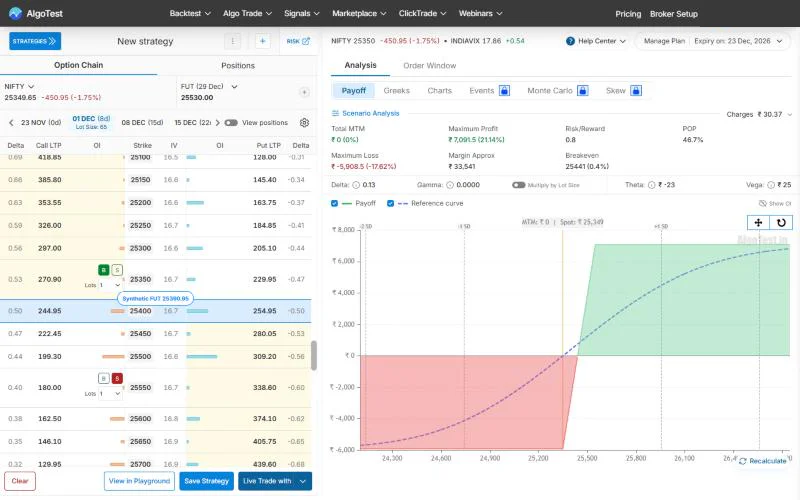
5. Check the numbers before you place it. Look at the net debit, maximum profit, maximum loss and breakeven. Make sure the maximum loss is an amount you're comfortable losing.
Place both legs together and plan your exit. Enter and exit the spread as one trade, not one leg at a time.
In SurendraAlgo's Strategy Builder, Bull Call Spread is a prebuilt strategy under Bullish. Pick it, choose the expiry, and both legs load with the payoff, breakeven and margin shown beside them. SurendraAlgo's docs walk through the same setup.
Bull Call Spread Example on Nifty
This is the spread in the screenshots, using closing prices on 23 November 2026 for the 1 December expiry. Nifty closed at 25,349.65.
That gives you:
Maximum loss: ₹90.90 per unit, if Nifty ends at or below 25,350.
Maximum profit: ₹109.10 per unit (the 200-point gap minus ₹90.90), if Nifty ends at or above 25,550.
Breakeven: 25,440.90, only about 91 points above where Nifty closed.
Here's how the trade ends at expiry for different Nifty closes:
With Nifty's lot size of 65 at the time, that's a maximum loss of ₹5,908.50 and a maximum profit of ₹7,091.50 per lot. Strategy Builder estimated about ₹33,500 in margin for one lot, well above the net premium, because the sold call needs margin. Check your broker's figure before you place the trade.
Move the sold strike and watch max profit and breakeven change. Build this spread in Strategy Builder
How to Pick the Strike Width
In any bull call spread option strategy, the gap between your two strikes decides most of the trade. Here's the same bought 25,350 call paired with three different sold calls, using the 23 November closing prices:
What the table shows:
The narrow spread costs the least and breaks even closest to spot, but it pays the least.
The wide spread can pay about four times as much, but it needs Nifty above 25,491 just to break even.
The plain call has no ceiling, but Nifty has to climb about 271 points before it makes any money.
Your target decides the width. If you think Nifty can reach 25,550 but not much more, selling the 25,550 call means you give up very little. If you're unsure how ATM and OTM strikes behave, start there before you set the width.
Bull Spread Option Strategy: Call Spread vs Put Spread vs Long Call
A bull spread is the umbrella name for spreads that profit from a moderate rise. A bull spread can be built with either calls or puts. The call version is a debit spread, and the put version is a credit spread.
A long call carries no profit ceiling, but costs more upfront and requires a larger price move to reach breakeven.
Related: Iron Condor Strategy Explained: How It Works, Payoff & Example
What Happens to a Bull Call Spread Before Expiry?
The payoff table above only shows the result at expiry. Before that, the spread behaves differently:
Its value moves slowly. Even if Nifty touches 25,550 early, the spread won't be worth the full 200 points yet, because the sold call still holds time value.
Volatility matters less. Because you hold one bought call and one sold call, the price of a bull call spread changes very little when volatility changes.
Time works against you. As with any options strategy, the passage of time works against the bull call spread, so a slow rise may not be enough.
Exit both legs together. Enter and exit the trade as one spread, not one leg at a time.
Watch the sold strike on expiry day. The risk is highest when the price is trading just below, at or just above the short call strike. Decide in advance whether you'll close early.
Related: Iron Fly vs Iron Condor: Which Paid More on a Real Nifty Expiry?
How to Test a Bull Call Spread Before You Trade It
A payoff graph shows one possible outcome. Testing shows how your exact rules held up across many sessions.
Replay a past session: the Option Simulator replays the historical option chain for a chosen date and time, so you can watch the spread through a real expiry day.
Backtest the rules: run the same entry time and width across months of Nifty data with Backtest, then repeat it with narrow and wide spreads. SurendraAlgo gives users 25 free backtests every week on Monday.
Practise with virtual money: try the spread on one of these paper trading websites or virtual trading apps before you go live.
If you want the spread placed automatically at a fixed time, compare how the best algo trading software in India handles multi-leg orders.
When to Use a Bull Call Spread (and When Not To)
Use it when:
You expect a moderate rise to a level you can name.
Call premiums feel too expensive to buy on their own.
You want a fixed maximum loss that you know before you enter.
Avoid it when:
You expect a sharp rally. The spread is ineffective in highly volatile or sharply rising markets, where a plain long call might perform better.
You're neutral or bearish, because the spread needs the index to rise.
Expiry is very close and Nifty is far below your bought strike, so there's little time for the move you need.
Put Numbers on Your Bullish View
"Nifty will go up a bit" isn't a trade. A bull call spread turns that view into fixed numbers: what you can lose, where you break even and where your profit stops. Choose the width from your target, decide your exit before you enter, then check how the setup held up on past expiries before you pay any premium.
SurendraAlgo helps you turn a trade idea into a strategy you can build, replay and test before you decide to deploy it. Join us as we simplify options trading in India.
Related Reading
FAQs
Is a bull spread the same as a bull call spread?
A bull call spread is one type of bull spread. You can also build a bull spread with puts, which is called a bull put spread. Both aim to profit from a moderate rise.
What is the maximum loss on a bull call spread?
The maximum loss is the net premium you paid, multiplied by the lot size. It happens if the index ends at or below the bought strike at expiry.
How do you calculate the breakeven of a bull call spread?
Add the net premium to the lower strike. In the example above, that's 25,350 + 90.90 = 25,440.90.
How much margin does a bull call spread need?
More than the net premium, because the sold call needs margin. In the example, Strategy Builder estimated about ₹33,500 for one Nifty lot. Your broker's figure may differ.
Which is better, a bull call spread or a bull put spread?
Neither is better in every case. A bull call spread costs money upfront and has a fixed maximum loss. A bull put spread pays you a credit upfront, needs margin, and can still make money if the index stays flat.
Can I backtest a bull call spread?
Yes. You can build both legs on SurendraAlgo and backtest them on past Nifty data, with your own entry time, strike width and exit rules.