A crude oil crash is a sharp fall in oil prices over a short period. On MCX, every rupee of that fall hits your position. One standard crude oil lot covers 100 barrels, so each ₹1 drop per barrel changes its value by ₹100.
Quick answer: what a crude oil crash does on MCX
A long futures position loses ₹100 per lot for every ₹1 fall per barrel, and a Crude Oil Mini lot loses ₹10.
A short futures position gains the same amounts, but it is exposed if prices bounce back.
Option buyers can only lose the premium they paid. Option sellers can lose much more.
A short put with no protection keeps losing as prices fall. A lower-strike protective put caps that loss.
MCX crude is linked to NYMEX WTI crude converted to rupees, so it does not move one-for-one with Brent.
Replay a falling crude oil session before you trade the next one. Sign up free on SurendraAlgo
MCX crude oil snapshot (20 November 2026): MCX December crude oil futures closed at ₹7,695 per barrel, down ₹112 (−1.43%) from the previous close. Brent crude closed at $92.57 a barrel on the same day.
How MCX Crude Oil Follows Global Prices
MCX crude oil is a rupee contract. Its price depends on two things: the US crude price and the dollar-rupee rate.
Crude oil on MCX is cash-settled, so nobody delivers barrels. Positions still open at expiry are settled at a final price linked to NYMEX WTI crude oil, converted into rupees.
This is why MCX and Brent can move in different directions on the same day. On 20 November, Brent closed higher while MCX December crude closed lower.
Before you trade the next big move, you need to know what it does to your own position. SurendraAlgo lets you replay past MCX sessions, build option positions and backtest crude oil strategies on historical data.
Same Fall, Different Positions
Take the ₹112 fall on 20 November. Here is what it meant for a trader who held each position from one close to the next, before costs.
The standard contract is ten times bigger than the Mini, so the same price move costs ten times more. Our crude oil lot size guide shows the full contract specifications, and the Crude Oil Mini guide covers the smaller contract.
Futures losses don't wait until you exit. Profits and losses on futures are settled every day. If losses take your balance below the required margin, you have to add money or your broker may close your position. Our MCX margin guide explains how this works.
See your position's P&L at any crude oil price before you place the trade, in the SurendraAlgo Strategy Builder.
What Happens If You Sold a Crude Oil Put?
Selling a put means you collect a premium now. In return, you promise to take the loss if prices fall below your strike. When crude falls hard, this is the trade that usually hurts most.
You can cap that risk with a protective put. This is a cheaper put that you buy at a lower strike. Selling one put and buying a lower one is called a bull put spread.
Real example from 20 November 2026, 9:16 AM: MCX December crude futures were at ₹7,763. The December options, which expire on 16 December, were priced at an implied volatility of about 50%.
Naked short put: Sell the 7,600 put for ₹340.60.
Bull put spread: Sell the 7,600 put for ₹340.60 and buy the 7,400 put for ₹253.20. Your net premium is ₹87.40.
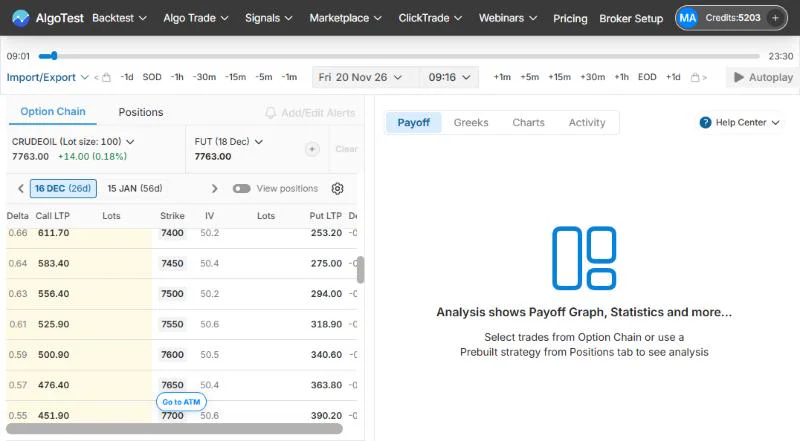


After a sharp fall, option premiums are high, so the naked put collects ₹34,060 per lot upfront. That is why selling puts looks tempting during a crash.
The spread collects only ₹8,740, because the protective 7,400 put is expensive too.
The naked put stays ahead until crude falls below about ₹7,147. Below that, the spread loses less, and its loss stops at ₹11,260 per lot.
The naked put has no floor. A fall to ₹6,500, about 16% below the entry price, would cost ₹75,940 per lot.
What the same day looked like: We replayed the 20 November session in the SurendraAlgo Option Simulator. Futures ended the session at ₹7,690, and the 7,600 put rose from ₹340.60 to ₹382.70. The naked put was down ₹4,210 per lot. The spread was down only ₹770, because the 7,400 put rose as well.
Expiry matters too. Crude oil options expire two business days before their underlying futures. A put that is in the money at expiry devolves, which means it becomes a position in the futures contract. A short put becomes a long futures position at the strike, so your exposure carries on unless you close it.
In the spread, both legs devolve and offset each other. Brokers may also block devolvement margin before option expiry and close positions that don't meet their funding rules. Our MCX options trading guide covers expiry rules in more detail.
You can check live strikes and premiums on the MCX option chain.
Test the naked put against the spread on 2026 crude oil data. Sign up to get 25 free backtests each week.
April 2020: When MCX Crude Settled Below Zero
April 2020 is the extreme case. It shows how far a crude oil crash can go.
On 20 April 2020, the front-month NYMEX WTI contract settled at −$37.63 a barrel.
MCX's April crude oil contract expired the same day.
MCX converted the WTI price into rupees at the RBI reference rate of ₹76.6335 and settled the contract at −₹2,884 per barrel.
A negative price means a long holder had to pay money on top of losing the full value of the contract. Below zero, each ₹1 still cost ₹100 per standard lot. The fall from zero to −₹2,884 alone came to ₹2,88,400 per lot, plus whatever the trader had already lost from their entry price down to zero.
Reports at the time said MCX traders lost crores, but estimates varied by source and by whose losses were counted. Two lessons hold either way:
MCX crude follows its US benchmark at settlement, even when that benchmark breaks every past pattern.
A position held into expiry takes whatever the final settlement price turns out to be.
How to Protect Your Crude Oil Trades in a Crash
Size each trade by the rupee loss you can accept, not by the margin you have available. Our position size calculator guide shows how to work this out.
Switch to Crude Oil Mini when a ₹100 move per ₹1 is too large for your account.
Use defined-risk spreads instead of naked option selling if you can't watch the evening session.
Keep money beyond the margin so daily mark-to-market losses don't force your broker to close you out.
Plan for the evening, because crude oil usually makes its biggest moves after 6:00 PM. The weekly EIA inventory report comes out on Wednesdays at 9:00 PM Indian time, and crude trades until 11:55 PM. Our MCX trading time guide lists the full timings.
Decide before option expiry whether you will close or hold, since in-the-money options devolve into futures.
Write your exit rule before you enter the trade. Our trading risk management plan can help you set one.
Test a Crash Scenario on 2026 Data
SurendraAlgo's MCX backtest data starts on 1 January 2026. You can test crude oil behaviour across this year's sessions, including the big rally and the falls that followed.
1. Replay the session in the Option Simulator
Open the SurendraAlgo Option Simulator, choose CRUDEOIL and move to the date you want, such as 20 November 2026.
Add your legs from the option chain first, then open the Charts tab to see how futures moved through the session.
The Simulator uses the standard CRUDEOIL contract, so divide the P&L by 10 to estimate one Mini lot.

2. Backtest the rules
We tested the same spread as a daily intraday strategy:
Sell a put three strikes below the at-the-money strike, and buy a put seven strikes below it, both on the monthly expiry.
Enter at 9:35 AM and exit at 11:00 PM, every trading day.

Results from 1 January 2026 to the latest data in November, after taxes and charges but before brokerage:
The strategy took 230 trades, and 57% of them made money.
The average loss (₹2,238) was bigger than the average win (₹1,651).
Before charges, it made ₹33,170. After taxes and charges, it lost ₹1,396.
The worst stretch was a ₹52,949 drawdown from 19 March to 10 July. June alone cost ₹32,185, as crude fell sharply from its highs.


A spread caps the loss on each trade, but that doesn't make a strategy profitable. Charges and a few heavy days in a crash can wipe out months of small wins. A backtest shows you this before your money does. These are backtested results on historical data, not live trades.
You can backtest MCX strategies on crude oil, natural gas, gold and silver. Each report shows total and year-wise P&L, cumulative P&L against the underlying, win rate, risk-reward ratio, maximum drawdown, winning and losing streaks, Monte Carlo analysis, DTE and weekend filter performance, and downloadable trade logs.
Compare the maximum drawdown with the money you hold beyond margin. That tells you whether a bad run would trigger a margin call. Our guide on how to backtest options trading strategies explains how to read the results.
3. Practise before going live
A good backtest doesn't mean you're ready for live crude oil trading. Run the same rules with virtual money for a few weeks, including some evening sessions and at least one weekly inventory report. Paper trading shows you how fills, slippage and late-night moves feel before real money is at risk.
Keep a simple log of each trade, and note where you broke your own rules. If the virtual results drift far from the backtest, find out why before you trade live. Most virtual trading apps let you review past trades, which makes this check easier.
Once the rules hold up in both tests, you can trade them manually or automate them with algo trading software so the exits run even when you're away from the screen.
Turn the Next Crude Oil Fall Into a Tested Plan
A crash is easier to handle when you have already priced it. Choose your contract size, decide whether you want a capped or uncapped loss, and set your exit before expiry. Then check how those rules held up across 2026 crude oil sessions, both calm and volatile.
SurendraAlgo helps you move from a rough idea about crude oil to a strategy you can replay, inspect and test before you decide whether to trade it.
Join us as we simplify retail trading in India.
Related Reading
FAQs
Can MCX crude oil go negative again?
It happened once, in April 2020, when MCX settled its crude contract at −₹2,884 per barrel. MCX's final settlement follows NYMEX WTI converted to rupees. If WTI settles below zero again, MCX crude can too.
How much do I lose per lot when crude oil falls ₹100?
A long standard Crude Oil lot loses ₹10,000, because it covers 100 barrels. A long Crude Oil Mini lot loses ₹1,000. Both figures are before brokerage and charges.
Does MCX crude oil follow Brent or WTI?
MCX crude oil settles against NYMEX WTI converted to rupees. Brent still affects overall market mood, but MCX can move differently from Brent on the same day.
What happens to my crude oil option at expiry?
Crude oil options expire two business days before their futures contract. Options that are in the money devolve into futures positions. Your broker may also ask for devolvement margin before expiry.
Is selling puts risky when crude oil is falling?
A naked short put keeps losing as prices fall, and the loss has no fixed limit. Buying a lower-strike put caps the loss, but it lowers your profit if prices stay up.