What is Algo Trading in India? Meaning, How It Works and Strategies
Algo trading uses computer code to place trades automatically. You set the rules. The software watches the market and executes orders the moment those rules are met. No manual clicking. No emotional decisions. No missed signals.The process of algo trading involves a series of systematic steps. First, traders or investors devise algorithms based on various factors such as price movements, technical indicators, market liquidity, and news sentiment. These algorithms are then fed into specialised software known as trading platforms, where they continuously monitor and analyse market data in real-time.
Retail traders in India use algo trading to compete with institutional speed and run strategies across Nifty, BankNifty, equity, and futures and options markets without sitting in front of a screen all day
Retail traders in India use algo trading to compete with institutional speed and run strategies across Nifty, BankNifty, equity, and futures and options markets without sitting in front of a screen all day
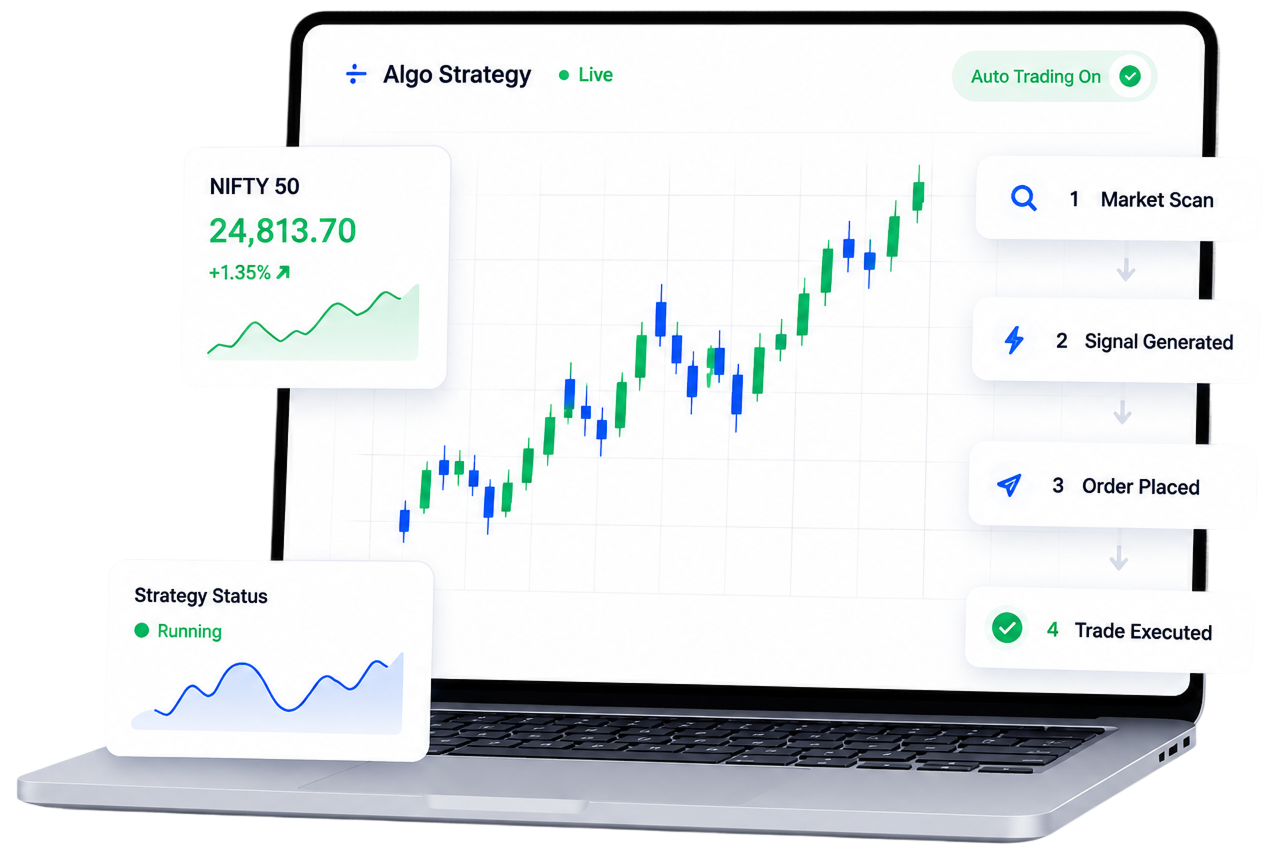
What is Algo Trading? Definition and Meaning
Algo trading, short for algorithmic trading, is the use of pre-programmed rules to buy and sell financial instruments automatically. The algorithm checks live market data, evaluates your conditions, and places the order in milliseconds, every time, with no human action required at the point of execution.
A simple example:
You build a rule that says "buy Nifty futures when the RSI on the 5-minute chart drops below 30, and exit when it crosses above 60." Once live, the algo monitors the market and executes those trades on its own.
Every algo trading system has five core components:

Strategy logic
Your entry, exit, and position size rules.

Market data feed
Live price and volume data from NSE or BSE.

Broker API
The link that routes orders to your broker automatically.

Risk management module
Stop-losses, daily loss limits, and position caps enforced by the software

Backtesting engine
Historical simulation to validate your strategy before you risk real capital.AlgoTest provides all five in one platform, built specifically for Indian markets.
*SurendraAlgo provides all five in one platform, built specifically for Indian markets.
How Does Algorithmic Trading Work in India?
Algo trading in India works through a simple sequence. Here is what happens from the moment you build a strategy to the moment it places a live order.
Step 1: Build your strategy
You define the conditions using SurendraAlgo's Strategy Builder. Choose your instrument, your entry and exit signals, your lot size, and your risk limits. No coding needed.
Step 2: Backtest on historical data.
SurendraAlgo runs your strategy against years of NSE and BSE data. You see returns, drawdowns, win rate, and trade frequency before deploying a single rupee.
Step 3: Paper trading (known as Forward testing on the platform).
SurendraAlgo runs your strategy in live market conditions using simulated capital. This is how you validate that your strategy works in real time, not just on historical data.
Step 4: Go live.
Connect your broker account, switch the strategy to live mode, and SurendraAlgo handles execution automatically. You monitor the P&L and logs in real time.
Step 5: Review and improve.
Performance data helps you refine your strategy over time. You adjust parameters, re-backtest, and re-deploy.
How broker APIs fit into automated trading
A broker API is the channel through which orders get placed automatically. SurendraAlgo connects to Indian brokers including Zerodha, Angel One, and Dhan. When your strategy triggers, SurendraAlgo sends the order directly to your broker via the API. You stay in control. The trade happens in under 50 milliseconds.
Is Algo Trading Legal in India?
Yes. Algo trading is legal in India for retail traders. SEBI permits automated trading when you follow a clear set of rules.
What SEBI requires:
- All automated orders must carry an algo tag at the exchange level. This applies to both NSE and BSE.
- You need your broker's approval to access their API for automated trading.
- Your system must include risk management controls, including daily loss limits and position size restrictions.
- You must maintain logs of all algo trades for audit purposes.
- You need to disclose the nature of your trading strategy to your broker.
SurendraAlgo works through your SEBI-registered broker account. Every live order goes through your broker's regulated infrastructure. That keeps your algo trading fully compliant.
Read more about Algo Trading Rules and Laws.
Read more about Algo Trading Rules and Laws.
Top Algo Trading Strategies Used in India
Indian retail traders use a range of algorithmic trading strategies across equity, index futures, and options markets. Below are the most popular ones, with practical examples for NSE and BSE markets.
1. Trend-Following Strategies
Trend-following algos enter trades in the direction of the prevailing market move. They use indicators like EMA crossovers, ADX, or Supertrend to identify when a trend is forming or accelerating.
Example: Buy Nifty futures when the 20 EMA crosses above the 50 EMA on a 15-minute chart. Exit when the 20 EMA crosses back below.
Works best for: Intraday and positional index futures trading on NSE.
*Trend-following strategies are popular because they require no prediction. The algo simply follows what the market is already doing.
2. Mean Reversion Strategies
Mean reversion algos assume that prices move away from their average and then return to it. They use Bollinger Bands, RSI, or Z-Score to find moments when prices have stretched too far.
Example: Sell a BankNifty options straddle when IV rank is above 90. Close the trade when IV drops or the position loses 50% of its premium.
Works best for: Options sellers targeting weekly Nifty and BankNifty expiries.
*India's high-frequency options market makes mean reversion a particularly relevant strategy for retail traders. SurendraAlgo lets you backtest these setups across multiple expiry cycles.
3. Momentum Strategies
Momentum algos identify assets gaining relative strength and enter trades in the direction of that move. They rely on rate-of-change indicators, relative strength rankings, or volume surges.
Example: Buy the top five Nifty 50 stocks with the highest 20-day returns at market open. Rebalance the basket every week.
Works best for: Positional equity and sector rotation strategies.
*Momentum strategies work well in trending markets. You backtest them to find the rebalancing frequency and stock selection criteria that suit your risk appetite.
4. Breakout Strategies
Breakout algos enter trades when price moves beyond a defined level, such as a resistance zone, a previous day high, or a volatility range.
Example: Buy a stock when it breaks above the previous day's high with above-average volume. Set the stop-loss at the previous day's low
Works best for: Intraday equity and F&O trading on high-volume NSE stocks.
*Breakout strategies are time-sensitive. Algo trading gives you an edge here because the
system can monitor hundreds of stocks simultaneously and execute the moment the condition
is triggered.
system can monitor hundreds of stocks simultaneously and execute the moment the condition
is triggered.
5. Options Strategies Built for Indian Markets
India is one of the most active options markets in the world. Retail traders use a variety of
algo trading strategies tailored to Indian weekly expiries and high IV environments.
algo trading strategies tailored to Indian weekly expiries and high IV environments.
Short Strangle or Iron Condor: Sell OTM calls and puts on Nifty or BankNifty to collect
premium. The algo manages the position and exits based on predefined P&L targets or stop-losses.
premium. The algo manages the position and exits based on predefined P&L targets or stop-losses.
Calendar Spreads: Exploit the difference in implied volatility between near-term and far-
term expiries. The algo monitors the spread and adjusts the position when the differential narrows
term expiries. The algo monitors the spread and adjusts the position when the differential narrows
Delta-Neutral Hedging: Continuously rebalance a position to stay market-neutral as the underlying moves. This requires frequent adjustments that are impractical to manage manually.
Ratio Spreads: Build structured risk/reward positions around key strike prices. The algo defines the strikes, monitors Greeks, and exits on target.
*Backtest any of these options strategies on SurendraAlgo using historical NSE data with full options analytics.
Benefits of Algo Trading for Indian Retail Traders
Benefit
Speed
No emotions
Backtesting
Consistency
Multi strategy
Scalability
What it means in practice
Orders execute in under 50 milliseconds.
No human can match that at Nifty expiry.
The algo does not panic, freeze, or chase.
It follows its rules every single time.
Test on 5 or more years of NSE and BSE data before risking any capital.
No missed signals. No skipped trades. The strategy runs whether you are watching or not.
Run a BankNifty strangle and an equity momentum basket at the same time.
Scaling a profitable strategy requires no extra effort. The algo handles the larger size.
What is Algo Trading Software? How to Choose the Right Platform in India
Algo trading software handles the data, logic evaluation, and order routing so you do not have to build your own infrastructure. For Indian retail traders, the right platform needs to offer:
- No-code strategy builder so you can build strategies without writing code.
- Historical backtesting on Indian data covering at least three to five years of NSE and BSE equity and F&O, including strike-level options data.
- Paper trading and forward testing to simulate live conditions before committing capital.
- Direct broker API integration with SEBI-registered Indian brokers.
- Options-specific tools including payoff charts, live Greeks, and IV rank data.
- Automated risk controls for daily loss limits, per-trade stop-losses, and position size caps.
- Clear performance reports with drawdown analysis, Sharpe ratio, and trade-by-trade P&L.
SurendraAlgo is the only Y Combinator-backed algo trading platform built specifically for Indian F&O and equity markets. It covers everything on this list and includes Signal AI, which lets you build, backtest, paper trade, and deploy strategies in plain English from a single dashboard. No third-party integrations needed.
Not sure which platform is right for you? Compare the best algo trading software in India for 2026.
Not sure which platform is right for you? Compare the best algo trading software in India for 2026.
How to Start Algo Trading in India: Step-by-Step
Step 1: Sign up on SurendraAlgo
Create a free account at algotest.surendraalgo.com. 25 backtests included, no credit card needed.
Step 2: Connect your broker
Link your existing demat and trading account via your broker's API. SurendraAlgo supports Zerodha, Angel One, Dhan, and more.
Step 3: Build or pick a strategy
Use the Strategy Builder, explore community strategies, or load a pre-built strategy from a SEBI-registered Research Analyst via RA Algos.
Step 4: Backtest it
Review P&L curve, max drawdown, Sharpe ratio, and monthly trade count. Read our guide on how to backtest options strategies with examples.
Step 5: Paper Trade it
Run the strategy on real market data with virtual capital for at least two weeks.
Step 6: Go Live
Switch to Live Trade mode. SurendraAlgo places orders through your broker automatically.
Step 7: Review and improve
Check slippage, compare live results to your backtest, and refine.
No coding required
SurendraAlgo's no-code builder and Signal AI let you design and deploy strategies in plain English. If you already use TradingView, you can automate your TradingView signals directly through SurendraAlgo.
Read the complete step-by-step algo trading checklist for beginners in India.
Read the complete step-by-step algo trading checklist for beginners in India.
Try Signal AI — Build Strategies in Plain English
Signal AI lets you describe your strategy in plain English and converts it into a working algo automatically. Build, backtest, paper trade, and go live from one dashboard. No coding. No third-party tools.
How broker APIs fit into automated trading
A broker API is the channel through which orders get placed automatically. SurendraAlgo connects to Indian brokers including Zerodha, Angel One, and Dhan. When your strategy triggers, SurendraAlgo sends the order directly to your broker via the API. You stay in control. The trade happens in under 50 milliseconds.
Risks of Algo Trading You Should Know Before Starting
We SurendraAlgo, a leading website that offers a comprehensive suite of tools and resources for algo traders. Our platform empowers users to design, backtest, and deploy complex trading algorithms without the need for extensive coding knowledge. The user-friendly interface allows traders to seamlessly navigate through various features and execute trade strategies easily.
Overfitting
A strategy can look perfect on historical data and fail completely in live markets. This happens when the strategy is optimised too tightly for past conditions. Always validate your strategy with out-of-sample data and at least two to four weeks of paper trading before going live.
Technical failures
Internet outages, broker API downtime, and server errors can interrupt live execution. Use a platform with monitoring alerts. Make sure you understand how to manually close positions if your automated system goes offline.
Market regime changes
A trend-following strategy that works well in a bull market will often underperform in a sideways or high-volatility market. Review your strategy's performance regularly and update it when market conditions shift.
Slippage and impact cost
The price you get in live trading is rarely identical to the price used in a backtest. Illiquid options strikes and large lot sizes increase this gap. Factor realistic slippage estimates into your backtesting parameters.
Regulatory compliance
SEBI requires proper API authorisation and algo order tagging. Using unapproved automation methods, such as screen-scraping or unofficial order injection, can result in account suspension.
Support
FAQs about Algo Trading on SurendraAlgo
1. What is Algo Trading, and how does it work on SurendraAlgo?
Algo trading in India is the automated execution of buy and sell orders on NSE and BSE using pre-coded strategy rules. A computer program monitors live market data and places orders when your defined conditions are met. You set the rules once. The software handles execution from that point on.
2. Is algo trading legal in India?
Yes. Algo trading is legal in India when you trade through a SEBI-registered broker using an exchange-approved API. Your broker must authorise your API access, and all automated orders must carry proper order tags. SurendraAlgo connects to your existing broker account, so all live trading happens through regulated infrastructure.
3. Is algo trading profitable in India?
Profitability depends on the strategy, not the platform. Algo trading improves execution quality and removes emotional interference, but it cannot turn a poor strategy into a profitable one. A well-backtested strategy with strong risk management and realistic slippage assumptions has a much higher chance of performing well in live markets. SurendraAlgo gives you the tools to validate strategies properly before you risk capital.
4. What is the best algo trading software for beginners in India?
Look for a platform with a no-code strategy builder, options-aware backtesting on Indian data, paper trading, and direct broker integration. SurendraAlgo meets all four criteria and offers 25 free backtests on signup with no credit card required.
5. What is the difference between algo trading and automated trading?
Automated trading refers to placing orders automatically without manual clicking. Algo trading is broader. It includes designing the strategy, backtesting it on historical data, optimising it, and then deploying it with automated execution. All algo trading is automated. Not all automated trading involves a rigorously designed algorithm.
6. Can I do algo trading with Zerodha in India?
Yes. SurendraAlgo integrates with Zerodha's Kite Connect API. You backtest your strategy on SurendraAlgo, connect your Zerodha account, and then deploy the strategy for live execution. SurendraAlgo handles the market monitoring and order routing through your Zerodha account.
7. What is backtesting in algo trading?
Backtesting is the process of simulating how a strategy would have performed using historical market data. On SurendraAlgo, you can backtest options strategies, equity strategies, and indicator-based systems using years of NSE and BSE data. The output includes P&L curves, drawdown charts, win rate, and Sharpe ratio. Backtesting is the first step in validating any algo trading strategy before you risk real capital.
8. Do I need a lot of money to start algo trading in India?
No. You can start with your existing demat and trading account and the capital you already trade with. SurendraAlgo itself is free to try. The capital requirement depends on the instruments you trade, not on the platform. Many traders start with paper trading on SurendraAlgo at zero cost to validate their strategies before committing any funds.
Why Indian Traders Use SurendraAlgo for Algo Trading
SurendraAlgo is built for Indian retail traders who want to trade systematically across equity, Nifty, BankNifty, and other F&O instruments. It is backed by Y Combinator and designed from the ground up for Indian market conditions.
Here is what traders use SurendraAlgo for:
Strategy design. Build strategies using a no-code visual builder or connect signals from TradingView and ChartInk.
Backtesting. Test strategies on deep historical NSE and BSE data with full options analytics, including Greeks, IV rank, and payoff charts.
Paper Trading (aka forward testing). Validate strategies in live market conditions before risking real capital.
Live trading. Deploy strategies across multiple broker accounts with automated execution and real-time monitoring.
RA Algos. Access pre-built strategies from SEBI-registered Research Analysts if you prefer ready-made systems over building your own.
Quick Links
Paper TradingF&O Margin CalculatorWhat is Algo Trading?Quantitative TradingFutures and OptionsCrypto TradingFinniftyWhat is Options Trading?Options ChartForex Trading in IndiaBank NiftyNifty Midcap 100SurendraAlgo vs QuantiplyNSE, BSE Trading Stock Market HolidaysNifty Option ChainSensex Option ChainFINNIFTY Option ChainMidcap Nifty Option ChainBank Nifty Option ChainTCS Option ChainBANKEX Option ChainHDFC Bank Option ChainAxis Bank Option ChainONGC Option ChainICICI Bank Option ChainTitan Option ChainBlack ScholesVirtual Coin TosserOpen Broker

Signup for
25 Free Backtest
25 Free Backtest
© 2026 All rights reserved. SurendraAlgo.