Quick answer: F&O trading means buying and selling futures and options (also written FnO), either to take a position on a stock or index or to hedge shares you already own. A future binds both sides to trade at a set price on expiry. An option buyer pays a premium for the right, but not the obligation, to buy or sell at a set price called the strike price.
You can close a futures or options position at any time before expiry.
Contracts trade in fixed lots, and one Nifty lot is 65 units.
SEBI found that 87.7% of individual traders in equity derivatives made a net loss in FY26.
Test your F&O idea before you trade it.Sign up free on SurendraAlgo and get 25 free backtests every week.
F&O Trading Example: Buying One Nifty Lot
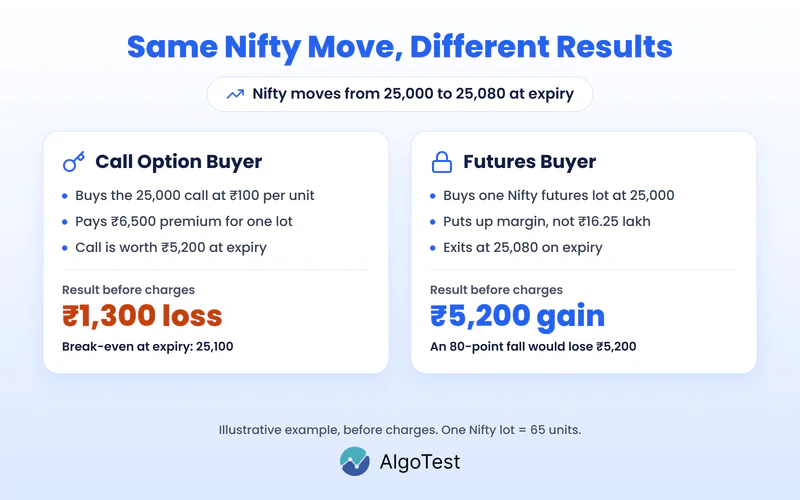
Suppose you buy one Nifty 25,000 call option at ₹100 per unit. One lot is 65 units, so you pay ₹6,500 in premium.
If Nifty settles at 25,080 on expiry, the call is worth ₹80 per unit, or ₹5,200 for the lot.
You still lose ₹1,300 before charges, even though Nifty finished above your strike.
Your break-even at expiry, the level where you neither gain nor lose, is 25,100 before charges.
Now suppose you had bought one Nifty futures lot at 25,000 instead. The same 80-point rise would earn ₹5,200 before charges, and an 80-point fall would lose ₹5,200. You’d pay only a margin, not the full ₹16.25 lakh contract value, which is why futures gains and losses grow fast compared with the money you put in.
Before you place a trade like this, you can check its payoff and break-even on SurendraAlgo.
Practise this trade on a real past session. Replay a past Nifty expiry minute by minute and buy or sell options with virtual money in the SurendraAlgo Option Simulator.
How Futures and Options Work
Futures and options are derivatives, which means their price comes from an underlying asset such as an index, a stock, a commodity or a currency pair. Exchange-traded equity derivatives in India began in June 2000, when BSE launched Sensex futures and NSE launched Nifty futures.
Futures Contracts
A futures contract is an agreement to buy or sell the underlying at a fixed price on a fixed date, and both sides must honour it.
If you buy (go long), you gain when the price rises and lose when it falls.
If you sell (go short), you gain when the price falls and lose when it rises.
Profits and losses are settled every day through mark-to-market, so your account is credited or debited daily until you exit.
The futures price usually differs slightly from the spot price, and the gap narrows as expiry approaches.
Options Contracts
An option buyer pays a premium to the seller, also called the writer, for the right to buy (a call) or sell (a put) at the strike price. Equity options in India are European-style, so you can sell a bought option any time before expiry, but exercise happens only at expiry.
A call option generally gains value when the underlying rises, all else being equal.
A put option generally gains value when the underlying falls, all else being equal.
Volatility and the time left to expiry also move the premium, so a call can lose value even on a day the index rises.
An option buyer can lose at most the premium paid, while a seller can lose much more if the market moves sharply.
Futures vs Options: Key Differences

Related: Options Volatility Glossary
How F&O Trading Works in India: Lots, Expiry, Margin and Settlement
Lot Size and Expiry Day
Index contracts can’t be bought one unit at a time. You trade in lots, and the exchange fixes how many units make one lot. Our Nifty lot size guide tracks every revision.
Lot sizes for November and December 2026 expiries
Source: NSE and BSE lot-size circulars and contract specifications.
If an expiry day is a trading holiday, expiry moves to the previous trading day. For example, the November 2026 monthly contracts expired on Monday, 23 November, because Tuesday, 24 November was a market holiday.
Contract Value, Margin and Leverage
Contract value is the lot size multiplied by the price, so one Nifty lot at 25,000 is worth about ₹16.25 lakh. Your broker blocks only a margin, based on exchange SPAN and exposure margin rules. You can estimate it with the free F&O margin calculator.
This is leverage. A small move in Nifty creates a large profit or loss compared with the margin you put up.
Settlement
Index futures and options settle in cash. Stock futures and in-the-money stock options that are still open at expiry are physically settled, so you may have to give or take delivery of the shares.
Latest F&O Rules in India (2024 to 2026)
SEBI’s FY26 annual report shows that equity options contracts traded fell 51.5% in FY26 (April 2025 to March 2026), even as options turnover grew. The April and May 2026 changes came after FY26 ended, so they aren’t reflected in those figures.
F&O Trading Charges and Tax
STT is charged on F&O sales and on exercised options. The higher rates have applied since April 1, 2026.
Source: NSE circular on revised STT rates, March 2026.
You also pay brokerage, exchange transaction charges, SEBI fees, stamp duty and GST. For anyone who trades often, these costs can turn a small gross profit into a net loss.
Profits and losses from eligible exchange-traded derivatives are generally treated as non-speculative business income. An individual’s net taxable business income is taxed at the applicable rates, so speak to a chartered accountant about audit and loss carry-forward rules.
Related: Options Trading: A Beginner’s Guide for Indian Traders
Is F&O Trading Risky? What SEBI’s Data Shows
SEBI’s study of individual traders in the equity derivatives segment, released in August 2026, found the following:
87.7% of individual traders made a net loss in FY26, compared with 82.1% before transaction costs.
Individual traders’ aggregate net loss was about ₹91,685 crore, down from about ₹1.12 lakh crore in FY25.
Options accounted for about 92% of aggregate individual losses.
The average net loss across active individual traders was about ₹1.17 lakh.
Source: SEBI, Profitability of Individual Traders in the Equity Derivatives Segment (FY25 to FY26), August 2026.
Backtesting can’t predict future returns. What it can do is show how a set of rules lost money in the past, including its worst drawdown and longest losing streak. To see what these numbers mean for options buyers and sellers, read is options trading profitable in India.
Common F&O Trading Strategies
Buying a Nifty put option can hedge a stock portfolio against a sharp fall, much like insurance.
Buying or selling index futures after a breakout or a moving-average crossover is the simplest way to act on a view about direction.
A bull call spread or bear put spread pairs a bought option with a sold one, which caps both risk and reward.
A short straddle sells a call and a put to earn time decay in a range-bound market, but a big move can cause large losses.
An iron condor adds bought options on both sides of a short strangle, so the maximum loss is known in advance.
To match a strategy to your market view, see our guide to the best option trading strategies in India.
Backtest your F&O strategy. See how a straddle, iron condor or futures breakout behaved on past Nifty and Sensex data, including drawdowns and losing streaks, with SurendraAlgo Backtest.
How to Start F&O Trading in India
Open a trading account with the F&O segment enabled. Your broker will ask for income proof, such as a bank statement or salary slip.
Learn the contract details of what you trade: lot size, expiry day, margin and settlement type.
Write down your rules before you trade, including entry, exit, stop loss, position size and the most you are willing to lose in a day.
Backtest your options strategy to measure its past losses and drawdowns in trending, sideways and volatile markets.
Practise with virtual money, through paper trading on live prices or a virtual trading app that replays past sessions.
If one lot is more than your risk budget allows, keep practising instead of trading live. When you do trade live, expect results to differ from tests because of slippage, rejected orders and partial fills.
Automating F&O Strategies
Some traders automate F&O strategies so orders go out the moment preset conditions are met, such as a time, a price level or an indicator signal. Since April 1, 2026, SEBI’s retail algo trading framework has applied to all brokers, and algo orders must go through broker-approved systems.
Automation doesn’t remove market risk, and live orders can still face slippage or partial fills, this comparison of algo trading software can help you pick a platform.
How to Test F&O Strategies on SurendraAlgo
SurendraAlgo is a no-code platform built for Indian options and futures traders. Each tool covers one step from idea to live trade.
Build a multi-leg position in the Strategy Builder and check its payoff, breakevens and combined Greeks before you place it.
Backtest time-based or signal-based strategies, using futures or options legs, on 1-minute historical data. Data covers Nifty, Bank Nifty, FinNifty, Midcap Nifty, Sensex, Bankex and supported NSE F&O stocks.
Review each backtest report for overall profit, win rate, maximum drawdown, return-to-drawdown ratio, expectancy and the longest losing streak.
Replay past market days minute by minute in the Option Simulator, or forward test on live markets with virtual money.
Turn indicator conditions into entries and exits for options or futures with Signals AI, without writing code.
Explore F&O strategies built by SEBI-registered research analysts in RA Algos.
Deploy a tested strategy through 60+ supported broker APIs, with leg-wise stop loss, target, trailing and re-entry settings.
Turn Your F&O View Into a Tested Plan
F&O trading rewards preparation more than prediction. Choose one underlying, write down your entry, exit and maximum daily loss, and check how those rules behaved across trending, sideways and expiry-day sessions before you put capital at risk.
SurendraAlgo helps you move from an F&O idea to a strategy you can inspect, backtest and paper trade before you decide whether to deploy it.
Join us as we simplify algo trading in India.
Related Reading
All Index Expiry Day: Calendar and How to Test an Expiry Day Strategy
Nifty Expiry Day: 7 Rules Every Options Trader Should Follow
Synthetic Futures in Options Trading: Formula and SurendraAlgo Guide
FAQs
Can I exit an F&O position before expiry?
Yes. You can square off a futures or options position at any time during market hours before expiry by placing an opposite order. Most F&O traders exit before expiry rather than holding to settlement.
What happens if I hold a stock option until expiry?
In-the-money stock options are physically settled. A call buyer takes delivery of the shares and pays for them, and a put buyer must deliver the shares. Out-of-the-money options expire worthless, and many brokers raise margins or close such positions in expiry week, so check your broker’s policy.
How much money do I need to start F&O trading?
To buy an option, you pay the full premium for one lot upfront, which can be a few thousand rupees. Futures and option selling need margin, which for one Nifty futures lot is usually more than ₹1 lakh. If you hold an in-the-money stock option or a stock future into expiry, you may need far more money, or the shares themselves, for delivery.
What is the current Nifty F&O lot size?
The Nifty lot size is 65 units, from January 2026 expiries. Bank Nifty is 30 units. Sensex is 20 units for November and December 2026 expiries and 25 units from January 2027 expiries.
Which day is F&O expiry in India?
Nifty weekly options expire every Tuesday, and Sensex weekly options every Thursday. NSE monthly contracts expire on the last Tuesday of the month, and BSE monthly contracts on the last Thursday. If that day is a trading holiday, expiry moves to the previous trading day.
Is F&O trading profitable?
For most individual traders, it isn’t: nearly nine in ten lost money in FY26, according to SEBI. Testing your rules shows how they behaved in the past, but it can’t guarantee future results.
What is the difference between F&O trading and intraday trading?
Intraday describes how long you hold a trade: you buy and sell within the same day. F&O describes the instrument you trade. You can trade F&O intraday or hold positions for days until expiry.
How is F&O income taxed in India?
Profits and losses from eligible exchange-traded derivatives are generally treated as non-speculative business income and taxed at your applicable rate. A chartered accountant can advise on audit requirements and carrying forward losses.
Can I practise F&O trading without real money?
Yes. Paper trading lets you place virtual trades on live prices. SurendraAlgo’s Option Simulator also lets you replay past market days and practise F&O trades without any risk.
Is F&O algo trading allowed for retail traders in India?
Yes. Since April 1, 2026, SEBI’s retail algo framework has applied to all brokers. Algo orders must go through broker-approved systems, and third-party providers must be empanelled with the exchanges.